Mario Kart 8 Deluxe
- This article is about the enhanced Nintendo Switch port of Mario Kart 8. For the digital soundtrack album on the Nintendo Music app, see Mario Kart 8 Deluxe (Nintendo Music). For the theme for Nintendo Sound Clock: Alarmo, see Mario Kart 8 Deluxe (Nintendo Sound Clock: Alarmo).
| Mario Kart 8 Deluxe | |||||||||||||||||||||||||||||
|---|---|---|---|---|---|---|---|---|---|---|---|---|---|---|---|---|---|---|---|---|---|---|---|---|---|---|---|---|---|
 For alternate box art, see the related gallery. | |||||||||||||||||||||||||||||
| Developers | Nintendo EPD Bandai Namco Studios | ||||||||||||||||||||||||||||
| Publishers | Nintendo Tencent Games (China) | ||||||||||||||||||||||||||||
| Platform | Nintendo Switch (enhanced for Nintendo Switch 2) | ||||||||||||||||||||||||||||
| Release dates | Mario Kart 8 Deluxe: April 28, 2017[1] April 28, 2017[1] April 28, 2017[2] April 28, 2017[2] April 28, 2017[3] April 28, 2017[3] April 28, 2017[4] April 28, 2017[4] April 28, 2017[5] April 28, 2017[5] April 28, 2017[6] April 28, 2017[6] April 28, 2017[7] April 28, 2017[7] December 15, 2017[8] December 15, 2017[8] December 15, 2017[9] December 15, 2017[9] November 30, 2018[10] November 30, 2018[10] March 29, 2019[11] March 29, 2019[11] January 17, 2020[12] January 17, 2020[12] March 16, 2020[13] March 16, 2020[13]Mario Kart 8 Deluxe – Booster Course Pass: October 6, 2023[14] October 6, 2023[15] October 6, 2023[16] December 1, 2023[17] December 1, 2023[17] | ||||||||||||||||||||||||||||
| Languages | English (United States) English (United Kingdom) Japanese Chinese (Simplified)[A][B] Chinese (Traditional)[A] Dutch French (Canada) French (Europe) German Italian Korean[A] Portuguese (Europe) Russian Spanish (Latin America) Spanish (Europe) | ||||||||||||||||||||||||||||
| Genre | Racing | ||||||||||||||||||||||||||||
| Ratings |
| ||||||||||||||||||||||||||||
| Modes | Single Player Multiplayer (2-4 players (Nintendo Switch), 2-8 players (Nintendo Switch 2, as of Version 4.0.0)) Local Wireless Play (2-12 players) Online Play (2-12 players) LAN Play (2-12 players) | ||||||||||||||||||||||||||||
| Format |  Game Card Game Card Digital download Digital download | ||||||||||||||||||||||||||||
| Input |  Joy-Con (horizontal) Joy-Con (horizontal) | ||||||||||||||||||||||||||||
| Serial codes | Mario Kart 8 Deluxe: LA-H-AABPA-JPN LA-H-AABPA-USA LA-H-AABPA-EUR LA-H-AABPB-CHN[33] Mario Kart 8 Deluxe + Booster Course Pass: LA-H-AABPK-JPN LA-H-AABPK-MSE | ||||||||||||||||||||||||||||
 - Everyone
 - All ages
 - Three years and older
 - All ages
 - All ages
 - General audience
 - All ages
 - Eight years and older
 - Three years and older
 - All ages
 - Six years and older
 - Three years and older
 - General
 - Parental guidance
Mario Kart 8 Deluxe is a racing game in the Mario Kart series released for the Nintendo Switch on April 28, 2017. It is an enhanced port of Mario Kart 8 for the Wii U and is the first Super Mario game overall to be released for the Nintendo Switch. The base game contains additional content such as several new characters and an overhauled Battle mode with new courses and modes. First teased in the Nintendo Switch's announcement video on October 20, 2016, the game was formally announced as part of the Nintendo Switch presentation on January 13, 2017.
Throughout 2022 and 2023, new race courses and returning characters were added to the game via the Mario Kart 8 Deluxe – Booster Course Pass paid DLC. An edition of the game that has the Booster Course Pass activated from the start, titled the Mario Kart 8 Deluxe Bundle (Game + Booster Course Pass), is available for purchase digitally.[34] A physical bundle was also released in Japan, Hong Kong, Taiwan, Southeast Asia, and mainland China.
A free update for the game was released on September 1, 2026, improving load times and visuals, support for up to 8 players locally in Multiplayer, and CameraPlay support when played on the Nintendo Switch 2.
Controls
| Action | Dual Joy-Con Pro Controller |
Motion | Joy-Con (horizontal) |
Toy-Con Motorbike | Toy-Con Car | GameCube Controller |
|---|---|---|---|---|---|---|
| Steer |  / /  ( ( ) )
|
Tilt  / / 
|
 or Tilt or Tilt
|
Tilt Toy-Con |  / / 
| |
| Accelerate / Rocket Start |  / /  / /  ↑ ↑
|

|
Tilt  Forwards Forwards
|
Pedal (Half Press) |  / /  / /  ↑ ↑
| |
| Brake / Reverse |  / ↓ / ↓
|

|
|
 / ↓ / ↓
| ||
| Item / Horn |  / / 
|

|
|

|

| |
| Drift / Hop / Trick | / 
|

|
|
Pedal (Full Press) |  / / 
| |
| Rear View | 
|

|

|
|

| |
Differences from the original
The following is a list of changes made to the base Mario Kart 8 Deluxe game from the latest version of Mario Kart 8, excluding changes that were fixed to be consistent with the original game in future updates.
General
- Characters, cups, and courses that were originally unlockable or exclusive to downloadable content in Mario Kart 8 are available from the start in this game; in addition, King Boo, Bowser Jr., Dry Bones, Inkling Boy, and Inkling Girl are added as new characters. This makes for the largest starting character roster or track selection of any home console Mario Kart game.
- Metal Mario gains an alternate costume known as Gold Mario, which is unlocked by clearing all cups in 200cc.
- A new Inkling Suit has been added to the Mii racing suits roster. It is usable by scanning an Inkling or Splatoon-series amiibo. In addition, the Animal Crossing Suit can be unlocked with any Isabelle or Animal Crossing-series amiibo.
- The game has reduced loading times.
Gameplay

- The Battle mode has been revamped.
- The overall game difficulty has been adjusted, as CPUs slow down when close to the player and do not charge Mini-Turbos or Super Mini-Turbos as quickly.
- The default speed of the CPUs in the Normal and Easy difficulties is slightly reduced.
- The rival system has been expanded: characters that did not have any in the original were given them, and characters who already had them swapped some in place of others.
- Motion controls are now turned on in the pause menu by pressing , rather than a toggle switching between it and stick controls.
- Two settings that aim to make playing easier for beginners have been introduced and can be toggled individually by each player in the vehicle part and pause screens:
- Smart Steering, which automatically steers the driver's vehicle to stay on the road and is represented by a antenna on the back of the vehicle.
- Auto-Accelerate, which is only available outside of Battle mode and makes the vehicle automatically accelerate.
- The pathfinding and drifting of CPUs in 200cc was reworked.
- The unlock criteria for various kart parts have been adjusted; some now have to be unlocked instead of being obtained from the start, while others are now obtained from the start instead of being unlockable. All kart parts that were DLC in the original game are now unlocked in the same manner as non-gold kart parts. New kart parts have been added, such as the Koopa Clown, the Splat Buggy, and the Inkstriker.
- Turning off the map, which is now turned on by default, is done by pressing in the pause menu, instead of
 at any time like in the original.
 - There is an additional level of Mini-Turbo, called Ultra Mini-Turbo, denoted by purple sparks (referred to as pink in the British English version) that appear after the orange sparks. This new level of Mini-Turbo can only be used if Smart Steering is off.
- A 200cc engine class in Time Trials was added; in addition to being separately recorded from the 150cc Time Trials, it features new staff ghosts.
- Some of the staff ghosts in Time Trials from the Wii U version were adjusted.
- There are more character weight classes than in the original, with several returning characters having different statistics.
- The player can now change controllers on the character selection screen by pressing
 or
or  .
. - The statistics of vehicle parts have been altered, and certain physics elements, such as the speed increase per stat and the acceleration tiers, were adjusted.
- Wireless and LAN modes were added, the latter returning from Mario Kart: Double Dash!!
- The minimum number of races and rounds in a VS Race or Battle is now four instead of three.
- The maximum number of races and rounds in a VS Race or Battle is now 48 and 25 respectively instead of 32 in both modes.
- CPUs choose from a wider variety of kart parts than in the original version.
- Being able to see which items the other drivers have, which was only possible when playing with the Wii U GamePad in the original, has now been removed entirely.
- Miiverse compatibility is absent, including the ability to upload Highlight Reels on YouTube; this feature was also discontinued in the Wii U version when Miiverse was terminated on November 7, 2017.
- An exploit in the original version that allowed players to gain speed by hopping after speed boosting has been fixed.
Items
- Characters can now carry up to two items at once, even if they do not equip the first item.
- The game features the return of the Double Item Box from Mario Kart: Double Dash!!
- Red Shells and Spiny Shells are now slower when they lock onto their target, meaning players are able to outrun them in 200cc when they have any kind of speed boost.
- Items are now based on distance and placement, rather than distance alone.
- The Boo is introduced as an item, with the Feather also appearing in Battle mode only.
- If a Blooper is about to ink the player as they cross the finish line, the player will now still get inked.[35] This is unlike the Wii U version, where the Blooper or the ink disappeared instead.
- CPUs now have a chance to obtain Triple Red Shells from Item Boxes, but this primarily only happens in the Shells Only item setting.
Online
- Playing online now requires a subscription to Nintendo Switch Online, rather than being tied to Nintendo Network.
- The dedicated lobbies for DLC copies and non DLC copies from the original game have been removed, as has the option to set whether or not tournament lobbies could be set to only allow the latter.
- Online lobbies have been changed in that a room entirely made up of players between 1000 VR and 3000 VR will be randomized between a 100cc or 150cc race, and a room full of players at over 3000 VR will be randomized among a 150cc, Mirror, or 200cc race, though the game normally selects 150cc. This is unlike the original game, where lobbies full of players between 1000 and over 4000 VR were put in 100cc, and lobbies full of players at over 5000 VR raced in 150cc.
- There is now an option to change character and kart parts in a lobby; this is done by pressing
 during the course selection of an online lobby.
 - Players are no longer positioned based on the order they joined.
- VR and BR distributions are slightly tweaked.
- Voice chat in private lobbies has been removed due to the Nintendo Switch's lack of a microphone.
Graphics
- The game now mostly renders in native 1920x1080 resolution in TV mode (sometimes switching to native 1728x972), and always renders at native 1280x720 resolution in tabletop and handheld mode, instead of the dynamic 1280x720/1152x648 rendering resolution used in the original Wii U version. This makes Mario Kart 8 Deluxe the first Super Mario title to render in native 1080p.
- The game runs at a constant 60 FPS, whereas the Wii U version would frequently dip to 59.
- The shadows present in the game are more detailed in multiplayer.
- Trophies can no longer be rotated, even when in handheld mode.
- All courses that feature confetti flying around the finish line, such as Mario Circuit, now also have confetti on the ground of the course near it.[36]
- When using the rear-view mirror, the character will now move their eyes slightly to the left to look back, like in Mario Kart Wii; however, their eyes will stay looking to the left as long as the rear-view is active, rather than switching back after a second as they do in Mario Kart Wii.
- When playing with teams, flags colored to correspond to the teams are added behind the vehicles. These flags do not appear in Balloon Battle and Bob-omb Blast, as the colors of the balloons represent the teams in these modes. When Smart Steering is on, the antenna serves as the pole of the flag.
- The Mii characters that represent the players in online lobbies wear racing suits, unlike in the original version in which they wore their regular outfits.
- The wireless and LAN modes use a very similar lobby to the online lobby, albeit visually set in a garage rather than on a globe.
- In online play, the Mii of the previous race or battle's winner wears a crown identical to the one worn by the first-place player in Battle mode.
- Motion blur when boosting is added to online play; in earlier builds, it was also present in splitscreen multiplayer.[37]
HUD/interface
- The user interface on the title screen and main menu has been revamped.
- All of the Toad icons are now on the left.
- The mode buttons appear longer, wider, and more spaced out.
- The options for playing online with one or two players have been combined, with the mode being renamed to "Online Play" due to this.
- For local multiplayer, there is now a sub-menu to choose the number of players to participate with.
- The new wireless and LAN modes were added to the menu. They use a very similar lobby to the online lobby, albeit set in a garage rather than on a globe.
- The Nintendo eShop icon that led to the DLC's shop page has been removed.
- The stamp counter icon has been removed.
- The status screen and amiibo menu, brought up by pressing and
 on Wii U respectively, now have their own dedicated icons on the bottom, replacing the prompts to open the equivalent menus from the Wii U game. Both menus have also been redesigned.
 - The Mario Kart TV icon was relocated from beneath the online play button on Wii U to being on the right of the amiibo icon.
- Much of the artwork on the entire menu was replaced and, after being unlocked, swaps out every time the game is opened.
- The game features an in-game guide, directly accessible from the game's menu; this guide explains various techniques, Battle mode, and the functions of each item. Much of its text is reused from the Wii U version's electronic manual.
- The menu in VS Race was redesigned.
- Scrollbars have been removed from the time trial menu. It also no longer shows Miiverse posts.
- Race rules and the course name are now displayed on loading screens in online matches.
- New tournament icons have been added in online play.
- The game no longer shows the state or province a player is located in on the loading screen of an online match or the loading screen in Mario Kart TV.
- In online matches, the flag displaying the country a player is in has been resized to be as big as the Mii icon next to it, as well as to display at a higher resolution.
- Players can now see the lap count or timer when spectating an online race or battle respectively.
- In races, the lap and coin counters have been moved closer to the bottom left corner.
- It is no longer possible to see the lap count when crossing the finish line or the full results in multiplayer (including online lobbies) at the end of the race while watching Highlight Reels via Mario Kart TV.
- The minimap features multiple alterations. When playing in local multiplayer, there is only one map in the center of the screen, rather than each player having their own copy of it like in the Wii U version. The color for the race courses in the Wii U version was typically blue, excluding the maps of the Rainbow Roads and GCN Baby Park, which were multi-colored. However, in this version, all minimaps are white, like in Mario Kart Wii and Mario Kart 7. Battle courses now have color-shaded areas and lines on their maps to serve as a visual representation of where the player is located. In a race, the player in first place no longer has a crown on their map icon, though they still do in battles. The icons for characters and the Spiny Shell on the course map are now slightly larger, more detailed, and of an increased resolution. Explosions caused by Spiny Shells and Bob-ombs are also now shown. From the Booster Course Pass onwards, the minimaps are generally rotated such that the starting line is facing upwards.
- All notifications use a different font.
- It is now possible to check which kart parts a ghost was using in time trials.
- Inkling Girl, Isabelle, and Link now appear on the loading screen, replacing the second set of characters from Wario to Bowser.
- The chart on the kart selection screen no longer rounds to the nearest whole number, creating a more accurate representation of the karts' stats.[38]
- The engine class for the upcoming race in an online race lobby is now shown in the lobby as the course is selected, via a "50", "100", "150", mirrored "150" (for Mirror), or "200" icon in the bottom right of the selected course icon.
- This extends to online battle lobbies, which will display a symbol of a yellow balloon (for Balloon Battle), a potted Piranha Plant (for Renegade Roundup), a coin (for Coin Runners), a Shine Sprite (for Shine Thief), or a Bob-omb (for Bob-omb Blast) to denote which Battle mode is about to be played.
Audio
- The game supports 5.1 surround. Effects that can play on the rear speakers include approaching shells, certain vehicles' engines, sceneries (e.g. bats, falling rocks, water, helicopters), and if other drivers are immediately to the side. Background music, Lakitu's countdowns, and menu sounds are mixed to stereo only. Some surround receiver producers' models may default to Standard modes that water out the effect (e.g. playing background music via side speakers), necessitating switching them to Straight/Direct or upmixing modes.
- Characters no longer vocally react to being inked by a Blooper.
- The faster variation of the course's theme in Battle mode now begins a minute before ending, rather than 30 seconds before.
Battle

The biggest change made between Mario Kart 8 Deluxe and the original release of Mario Kart 8 is the Battle mode. Battle mode now returns to the arena-based style, adding eight new battle courses, each with its own course intro (replacing the eight Battle mode race tracks from Mario Kart 8) and unlike previous games, each player starts with five balloons, as opposed to three. Another addition to Battle mode is that the character in the lead now wears a crown, unlike in Mario Kart 8 where the crown is displayed only on the HUD map. Additionally, players now start out with zero points instead of Mario Kart 8's default three points, and their balloons do not serve as the remaining three points.
Returning from Mario Kart Wii and Mario Kart 7 is the ability to respawn after all balloons are popped; this causes the player's total score to halve and the player respawns with three balloons instead of five. A new addition to this mode is the feature to tell exactly which character hit whom, which appears on the bottom of the screen. After getting hit, players now have about 1.5 seconds of invincibility frames, unlike in Mario Kart 8. The item options also appear to have been updated; the item-specific options have been removed, while a new "Skilled Items" option is now available for selection; in this option, powerful items appear less frequently, similar to Mario Kart Wii's "Strategic" ("Basic" in the British English version) item option.
There are five different Battle mode types, with two of them (Renegade Roundup and Coin Runners) also featuring the "No Items" item option:
- Balloon Battle: The classic mode where players use items to pop opponents' balloons or steal them in order to score points. This mode now uses the point-based set-up seen in Mario Kart Wii, and Mario Kart 7, rather than the survival set-up of Mario Kart 8 and earlier installments prior to Mario Kart Wii.
- Renegade Roundup: A new mode in the vein of "cops and robbers", with the racers being divided into two teams. One team, known as "The Authorities", has to use Piranha Plant items (which are permanently attached to the front of their vehicle and only serve to capture the opposing team; they do not operate like the regular item) in order to capture players from the other team, known as "The Renegades". Captured Renegades are placed into one of several jail cells floating above various points on the stage. Remaining Renegades can free their teammates by driving over a key switch placed below the jail cells. The Renegades win if at least one member is still running free when time runs out, and the Authorities win if all of the Renegades get captured. All Authority team members also temporarily lose their ability to capture after being hit by an item and Renegades receive a speed boost and temporary immunity when they are freed from the cells.
- Bob-omb Blast: A returning mode from Mario Kart: Double Dash!!, in which players attack one another using Bob-ombs to score points and can carry up to 10 Bob-ombs. This version follows nearly all of the same rules as Balloon Battle, the differences being these: the only items are Bob-ombs, players cannot be hurt by their own Bob-ombs exploding, and Bob-ombs thrown forward explode instantly.
- Coin Runners: Originating in Mario Kart Wii, this mode was last seen in Mario Kart 7. Players must collect Coins scattered across the course in order to have the most by the end of the match. Plays more akin to the Mario Kart Wii version of the mode, with players having no limit to the amount of coins they can collect, as opposed to the 10-coin limit in the Mario Kart 7 version.
- Shine Thief: Another returning mode from Mario Kart: Double Dash!!, one player must retrieve a Shine Sprite and keep hold of it for about 20 seconds, while the opponents use items against whoever has the Shine to force that player to drop it. The driver holding the shine sprite has a slightly reduced top speed. In Team play, one team must collectively manage to hold on to the Shine for about 30 seconds.
There is also the option to randomly select one of the five available modes by choosing "Random Battle", which changes the Battle type after each round. The Round Count option has also been adjusted for Random Battle, with options for 5, 8, 10, 15, 20, and 25 rounds instead of 4, 6, 8, 12, 16, and 24 rounds from the separate Battle types.
Characters
There are a total of 50 playable characters in Mario Kart 8 Deluxe, including 42 in the base game and eight as DLC. The two Inklings and Villagers, despite having different stats, animations, and rivals compared to their counterparts, share slots with their counterparts as of version 3.0.0, bringing the total slots down to 48. All base and DLC characters from Mario Kart 8 are present in the base roster of Mario Kart 8 Deluxe and are now available from the start, while more characters that were not present in Mario Kart 8 are also added. The base game includes returning characters Bowser Jr., King Boo, and Dry Bones, who last appeared in the series as playable characters in Mario Kart Wii, and Gold Mario (as a variant of Metal Mario), who was previously playable in Mario Kart Arcade GP DX. It also introduces two new non-Super Mario characters, being the Inkling Girl and Inkling Boy from Splatoon. Both Inklings have three selectable colors each. At the game's launch, Inkling Girl and Inkling Boy took up separate slots on the character selection screen, as did the two Villagers, who were originally present in the same character slot (with the female Villager being a variant of the male one) in Mario Kart 8. However, with the version 3.0.0 update, Inkling Boy and female Villager now share slots with Inkling Girl and male Villager respectively. Despite sharing slots, female Villager and Inkling Boy can still appear in races if the other Villager or Inkling is present, and they continue to have different stats compared to their counterparts.[39]
Eight additional characters were added as downloadable content via the Booster Course Pass, starting with its fourth wave. Characters added include Birdo, who was added in Wave 4 with nine selectable colors, Petey Piranha, Wiggler, and Kamek, who were added in Wave 5, and Diddy Kong, Funky Kong, Pauline, and Peachette, who were added in Wave 6.[40] Wiggler, Gold Mario, Kamek, Pauline, Peachette, and all Birdo variants are playable for the first time in a home console Mario Kart installment. Kamek, Pauline, Peachette, and almost all Birdo variants were originally introduced in Mario Kart Tour, which released after Mario Kart 8 Deluxe. With Birdo's inclusion in Wave 4 and Diddy Kong and Funky Kong's inclusion in Wave 6, all playable characters from Mario Kart Wii are now included in Mario Kart 8 Deluxe.
There is only one unlockable character in this game, that being Gold Mario. He is unlocked by clearing all cups of the 200cc Grand Prix. Additionally, the version 1.6.0 update added a new variant for Link, Champion's Tunic Link,[41] based on his appearance in The Legend of Zelda: Breath of the Wild. When Gold Mario is unlocked and Champion's Tunic Link is downloaded, they become the default variations of their character, while Metal Mario and the version of Link based on his appearance in The Legend of Zelda: Skyward Sword are relegated to alternate costumes. As of the 3.0.0 update, however, the character select screen now remembers the last costume used for characters with alternate costumes.
There are more individual character weight classes when compared to the Wii U game, with several returning characters having different statistics, thus resulting in fewer characters having the same stats as each other.
Characters, variants, and Mii racing suits playable in this game that are not playable in the original Mario Kart 8 are listed in italics.
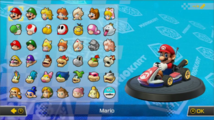 Character select screen at launch
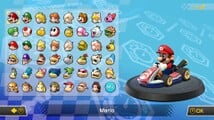 Character select screen with Gold Mario unlocked and all DLC characters downloaded


 |
 |
 |
 |
 |
 |
 |
 | ||||||||
|---|---|---|---|---|---|---|---|---|---|---|---|---|---|---|---|

|

|

|

|

|

|

|

| ||||||||
 |
 |
 |
 |
